
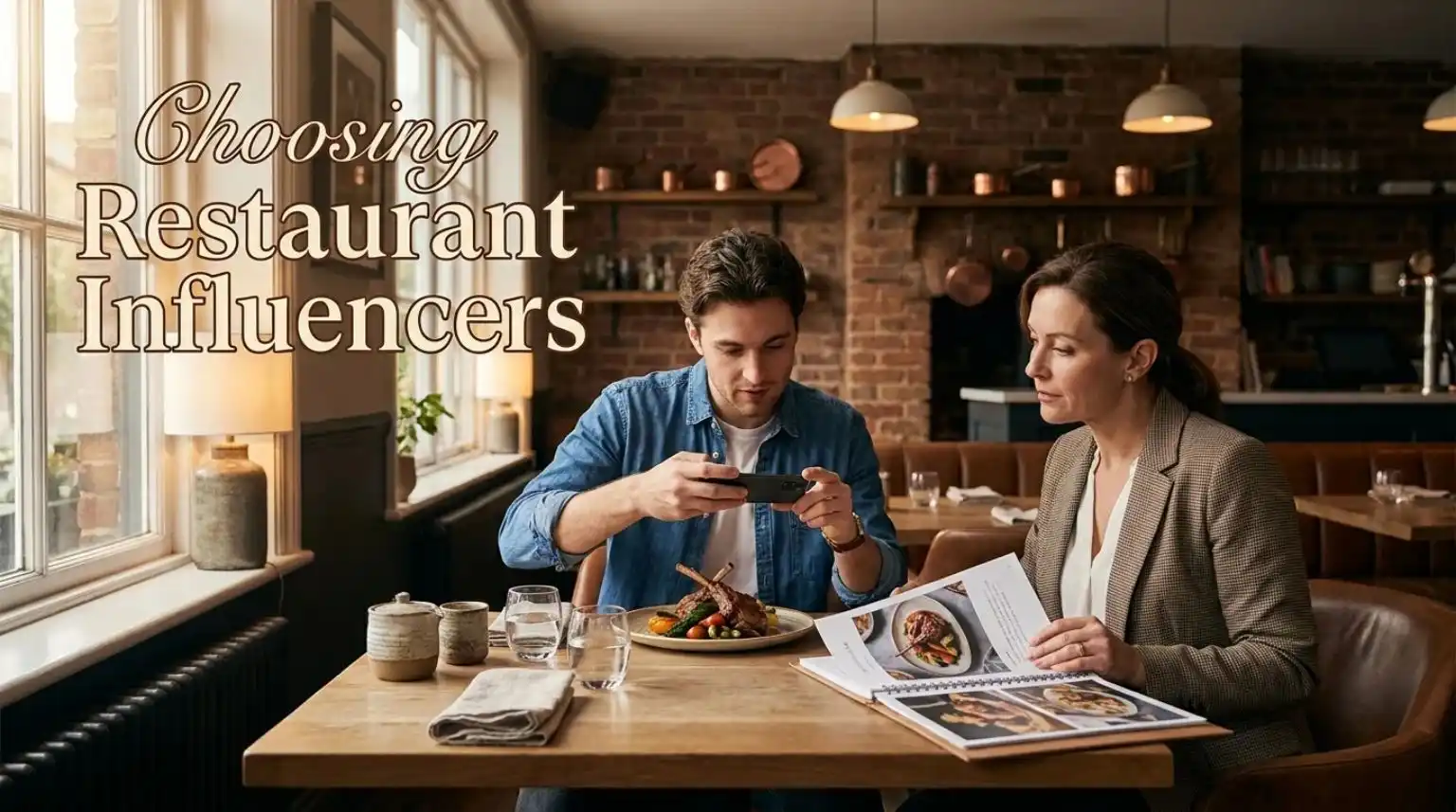
Choose restaurant influencers whose audience matches the diners you want to reach, whose recent food content suits your restaurant and whose proposal clearly states what you will receive. Ask for evidence of local reach before committing to a fee or complimentary meal.
Follower count can help describe an account’s size. It cannot tell you whether the people watching are likely customers, or whether the creator will deliver useful work.
Decide which diners you want to reach
Write a short selection brief before looking at accounts. Name the dining occasion, the area customers can realistically travel from and the result you want to assess.
For example: “We want people in and around our neighbourhood to consider us for a midweek dinner, with completed reservations as the outcome to review.” A destination restaurant attracting weekend visitors may need a different audience from a café seeking nearby lunch customers.
Also set an affordable limit for the collaboration, including any fee, hosted meal and additional content costs. This gives you a basis for comparing proposals.
Where to look for local food influencers
Start with the places and meals your customers already care about:
- Search Instagram and TikTok with a place and food interest. Try your town, neighbourhood, cuisine or dining occasion, such as “York independent restaurants” or “Harborne brunch”. Read the actual posts before adding an account to your list.
- Review posts about nearby restaurants. Look at tagged content and relevant location references. Include independent visits as well as clearly disclosed collaborations.
- Search the web for local food bloggers. A writer covering neighbourhood openings may suit a detailed dining recommendation better than an account focused on short videos. Check that they still publish and cover your area.
- Ask nearby operators about their experience. A useful recommendation describes communication, delivery and the work produced. An introduction alone does not establish that the creator suits your customers.
Keep a short list of accounts with relevant recent work. You can investigate suitable candidates without buying a discovery tool or contacting everyone at once.
Check the evidence behind each account
Verify the audience’s location
A creator living nearby may have followers across the country or overseas. A location in their bio is a starting clue, not proof of local customer reach.
Ask for recent, aggregated audience insights showing the location information available for the platform you are considering. On Instagram, this can include followers’ top locations. Ask the creator to show the account, reporting period and what the figures describe, with private information hidden.
Distinguish followers from people reached by content. Someone’s follower base may be local while a particular video travels much further. Request viewer or reached-audience information for comparable food posts where available, and keep each platform’s evidence separate.
Check these details when reading the figures:
- Is the geography specific enough for your restaurant’s catchment?
- Does a percentage refer to followers, viewers or another audience?
- Are the figures current and relevant to the proposed platform?
- Do they cover the whole account or a particular post?
A country-level breakdown cannot establish neighbourhood relevance. Equally, a list of top cities may not reveal everyone living nearby. Record missing detail as uncertainty. If locality is essential and the available evidence is too broad, ask for clarification before agreeing.
Compare recent restaurant posts fairly
Ask to see several recent posts similar to the work being proposed. Look for the normal pattern across them, including less successful posts, rather than a media kit showing only the largest result.
Compare like with like: a restaurant Reel with other restaurant Reels, for example. Note each post’s date and how long it has had to gather views. Ask whether paid promotion or a giveaway affected any unusually large result.
Views, saves and shares can help assess attention. Comments can add context: questions about the menu, access, prices or booking show a different kind of interest from a string of general compliments. Look at whether the creator answers those questions accurately.
None of this proves that commenters live nearby or will book. Short comments and low engagement do not prove an account has fake followers, either. Use unusual patterns as reasons to ask questions, rather than making accusations or applying a universal engagement-rate pass mark.
Judge the dining experience they communicate
Watch how the creator presents restaurants like yours. Can a viewer understand the food, atmosphere, likely spend and reason to visit? Do the recommendations contain useful detail, or could the same caption describe almost any venue?
Match the creator’s interests to the customers you want. An account known for affordable lunches may suit a neighbourhood café. A restaurant offering a longer tasting menu needs evidence that the creator’s audience is interested in that experience and price point.
Check factual care as well as attractive pictures. Previous posts should distinguish a genuine offer from a permanent price and avoid unsupported claims about dietary suitability. Consider whether their filming style would work in your dining room without disrupting service or other guests.
Assess reliability before the visit
Notice how the creator handles your initial questions. A clear reply, realistic availability and a proposal that addresses your restaurant are useful signs.
Ask for examples of comparable collaborations and, where appropriate, a restaurant reference they have permission to share. Establish what any reported result actually means. Booking-link clicks are different from reservations confirmed in a restaurant’s records.
A newer creator may have no paid campaign history. That leaves less evidence to assess; it does not establish poor conduct. Decide whether their existing work and a limited first arrangement provide enough confidence for your budget.
Put smaller and larger creators through the same checks
A smaller creator with a relevant local audience may be more suitable than a large account whose viewers are unlikely to visit. Restaurant micro influencers are worth considering, but size alone does not establish trust, affordability or results.
A larger creator may still be suitable when they can demonstrate relevant reach. For example, a destination restaurant may value an audience that travels for food. Use the restaurant’s actual purpose to judge both candidates, then compare their specific proposals.
Ask what the arrangement includes
Once a creator looks suitable, clarify the proposal before confirming a visit. These questions help reveal whether two quotes cover comparable work:
- What will you publish, and where? Confirm the platform, account, format, number of posts and any separate delivery of finished files. Making content for your channels and posting to the creator’s audience are different deliverables.
- When will the visit, delivery and publication happen? Include any important menu or event dates and how long content is expected to remain available.
- What is the total cost? Clarify the fee, any VAT, travel or production charges, hosted guests, food and drink allowance, and separate rights charges.
- What can we reuse? Agree the channels, duration, permitted edits and whether paid advertising is included. Credit or receipt of a file should not be treated as blanket permission.
- How will factual checks and changes work? Agree how to correct names, prices, availability or other errors while preserving the creator’s honest opinion.
- What happens if plans change? Confirm payment timing, cancellation, rescheduling and what happens if agreed work is not delivered.
- What reporting will you provide? Agree the available post insights and reporting date, including any limitations on connecting activity to bookings or orders.
Put the agreed terms in writing. Count the restaurant resources involved too: staff time and hosting still have a cost when there is no cash fee. If a meal is offered without an obligation to post, treat it as an invitation rather than a guaranteed content delivery.
Confirm how advertising will be disclosed
Choose someone willing to identify advertising clearly. Under CMA guidance for content creators, incentives include gifts and free services. Content arising from a complimentary restaurant visit can therefore need an advertising label even when no fee changes hands or post was required.
Agree clear, prominent identification such as Ad at the start, visible before someone has to expand a caption or watch further. #gifted or a restaurant tag alone is not an adequate substitute. Check each promotional Story or other item that people can view separately.
The ASA/CAP guidance explains that its advertorial remit generally involves both payment or another incentive and editorial control. Consumer-protection disclosure obligations can still apply without that control. An informal arrangement does not remove them.
The restaurant also has responsibilities. CMA guidance for brands advises setting expectations, checking posts and addressing incorrect labelling. Agree who will check the published content and arrange corrections.
A hosted meal does not entitle you to an artificially positive review. The creator’s account should reflect their genuine experience.
Compare your shortlist and make the decision
For each candidate, record Strong, Unclear or Weak against the checks below, with a short evidence note. Strong means suitable and supported; Unclear means a useful fact is missing; Weak means the available evidence shows a mismatch. These are practical decision labels, not an industry scoring standard.
| Check | Evidence to record | Your assessment |
| Audience geography | Current location data relevant to your catchment | Strong / Unclear / Weak |
| Dining fit | Comparable venues, occasions and price points | Strong / Unclear / Weak |
| Recent content response | Several comparable posts and relevant interactions | Strong / Unclear / Weak |
| Content suitability | Useful presentation, factual care and workable filming | Strong / Unclear / Weak |
| Professional reliability | Clear communication, dates and relevant work | Strong / Unclear / Weak |
| Proposal and value | Deliverables, total cost and reuse permissions | Strong / Unclear / Weak |
| Disclosure | Clear agreement to identify ads properly | Strong / Unclear / Weak |
Prioritise the checks that matter to your purpose. Excellent food photography cannot make up for an unsuitable audience when your aim is local bookings. A refusal to disclose advertising properly is a reason to decline, regardless of the follower count.
Pause when a proposal promises guaranteed customers, important deliverables remain vague, or evidence is repeatedly avoided without explanation. Ask a specific follow-up question where the issue could be clarified. If a necessary point remains unresolved, you can decline without concluding that the creator has acted dishonestly.
Choose the candidate with the clearest evidence of fit and an arrangement you can afford. If nobody meets the essential checks, keep looking rather than treating the shortlist as a commitment to book someone.
Use the first collaboration to inform the next choice
Before agreeing, choose what you will assess and how you can record it. After publication, review delivery and audience response separately:
- Delivery: Did the creator attend, publish on time, supply the promised work and disclose correctly?
- Attention: What reach, views, saves, shares or relevant questions did the content receive?
- Restaurant outcomes: Where tracking allows, check attributable enquiries, completed reservations, redeemed codes or orders in your own records.
A booking click does not confirm a reservation, and a confirmed reservation does not confirm seated covers. Code use or a tracked booking may help connect a result to the collaboration, but does not establish that every customer was new or would otherwise have stayed away.
If attribution is incomplete, say so. Use what you can verify, alongside content quality and reliability, to decide whether another collaboration is justified.
If you would like support with selection and the wider collaboration, see DigiZee’s restaurant influencer marketing service or contact us to discuss your restaurant’s needs.